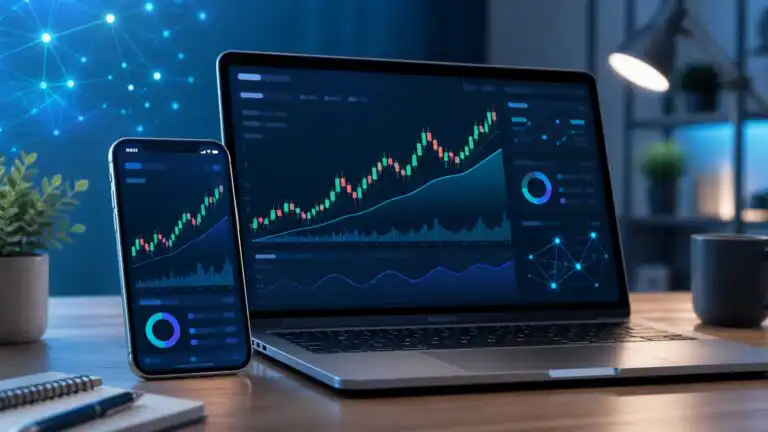
Artificial intelligence is entering the world of personal finance. From automated market analysis to intelligent investment tools, a new generation of trading applications is attracting attention worldwide.
TECHNOLOGY & FINANCE — OCTOBER 2026
The financial world is undergoing a major technological transformation.
Artificial intelligence, once associated primarily with research laboratories and large technology companies, is becoming increasingly accessible through everyday financial applications.
One of the most discussed developments is the rise of AI trading apps — digital platforms that use algorithms, data analysis and machine learning to support investment decisions.
These technologies promise to make complex financial information easier to understand and allow users to explore markets through increasingly sophisticated digital tools.
But an important question remains:
Could AI trading applications fundamentally change the way ordinary people approach investing?
A New Era of Digital Investing
For decades, active financial trading required specialist knowledge, access to market information and a considerable amount of time.
Today, technology has changed that environment.
Modern investment applications provide access to market prices, portfolio analytics, educational resources and automated monitoring tools.
Artificial intelligence introduces another layer of functionality.
Instead of simply presenting historical market data, some systems can identify patterns, compare scenarios and generate analytical insights.
For experienced investors, these tools may support research and risk assessment.
For beginners, they may offer a more accessible introduction to financial markets.
However, accessibility should never be confused with profitability.
How Does an AI Trading App Work?
An AI trading application typically combines several technologies.
The first is data processing. Financial markets generate enormous amounts of information every second, including price movements, trading volumes and economic announcements.
Machine-learning models may analyze this information to identify statistical relationships.
The second component is automation.
Certain applications allow users to define trading rules, monitor market conditions or execute transactions through connected brokerage accounts.
The third component is portfolio analysis.
Some platforms evaluate investment exposure, asset allocation and historical volatility to help users understand potential risks.
More advanced systems may also incorporate financial news analysis and natural-language interfaces.
Despite these capabilities, AI cannot reliably predict every market movement.
Unexpected economic events, incomplete data and changes in investor behavior can produce outcomes that automated models fail to anticipate.
Why Is Interest Growing in 2026?
Several developments are contributing to the growing interest in AI-powered financial applications.
Artificial intelligence models have become more capable of processing complex information.
Cloud computing has made advanced software more accessible.
At the same time, financial technology companies are competing to offer simpler, more personalized user experiences.
This combination has encouraged the development of tools designed for different levels of financial experience.
Some applications focus on investment education.
Others provide research assistance, algorithmic strategies or automated portfolio management.
The variety of available services is expanding, although their capabilities and regulatory status can differ significantly.
Can AI Really Make Better Trading Decisions?
Artificial intelligence can process certain types of information faster than humans.
Algorithms may detect statistical patterns, compare historical scenarios and apply predefined rules without emotional hesitation.
However, this does not mean AI systems consistently outperform human investors or financial markets.
A model trained on historical data can perform poorly when economic conditions change.
Transaction fees, market volatility and execution delays can also affect results.
Some strategies may appear successful during simulations but fail when used with real money.
This is why independently verified performance information and transparent risk disclosures are essential.
No legitimate trading app can guarantee profits or completely eliminate the possibility of financial loss.
AI Trading Apps and the Rise of Automated Finance
Automation is already an established part of professional financial markets.
Major financial institutions use quantitative models, automated execution systems and risk-management software.
The newer development is the availability of some comparable analytical functions through consumer applications.
This does not mean retail users have access to identical technology or investment opportunities.
Institutional trading systems typically operate with different data sources, infrastructure, regulatory requirements and levels of risk management.
Nevertheless, consumer financial technology is evolving rapidly.
The most useful applications may be those that improve transparency, financial understanding and decision-making rather than encouraging users to trade excessively.
Five Features to Look for in an AI Trading App
1. Transparent Technology
A trustworthy provider should explain what its software does and distinguish between automated execution, market analysis and investment recommendations.
2. Regulatory Information
Users should be able to identify the legal company operating the service and verify any required financial authorization.
3. Risk-Management Tools
Useful features may include exposure limits, portfolio monitoring and notifications about unusual market movements.
4. Clear Fees and Withdrawal Conditions
Trading commissions, subscriptions, spreads and other charges should be clearly disclosed.
5. Realistic Performance Claims
Historical performance should be accompanied by an explanation of its limitations.
Promises of guaranteed daily income or risk-free profits are major warning signs.
What Are the Biggest Risks?
The growing popularity of AI has also created opportunities for misleading financial advertising.
Some websites describe ordinary automated trading software as revolutionary technology without providing verifiable evidence.
Others misuse the names or images of well-known entrepreneurs, politicians or financial institutions to suggest official endorsements.
Such claims should always be independently verified.
Users should also consider cybersecurity risks, protection of personal financial information and the reliability of any connected broker.
A polished website and sophisticated technical language do not establish that an investment service is legitimate.
Could AI Trading Replace Traditional Financial Advisers?
Artificial intelligence may increasingly assist with financial research, monitoring and routine analysis.
However, financial planning often involves circumstances that automated models cannot fully evaluate.
Tax considerations, personal responsibilities, financial goals and individual risk tolerance are important factors.
Professional financial advisers may provide broader guidance that considers these circumstances.
Rather than replacing every traditional financial service, AI may become one component of a wider financial technology ecosystem.
The Future of AI-Powered Investing
The next generation of trading applications could feature more sophisticated analytical tools, personalized educational resources and improved interfaces.
Users may increasingly interact with financial software through conversational AI systems.
Automated models could also support real-time portfolio monitoring and scenario analysis.
However, these advances will require stronger attention to reliability, transparency and consumer protection.
Regulators are already examining the risks associated with artificial intelligence in financial services.
The central challenge will be ensuring that technological innovation produces genuine value rather than unrealistic expectations.
Conclusion: A Financial Revolution or Just Another Technology Trend?
AI trading apps represent an important development in digital finance.
They can make financial information more accessible and help users analyze complex market conditions.
But their growing popularity should not obscure the risks of investing.
Technology can support decisions, but it cannot remove uncertainty from financial markets.
The future of AI trading will depend not only on the sophistication of the algorithms, but also on the transparency, security and reliability of the platforms offering them.
For investors interested in the next generation of financial technology, understanding both the opportunities and the limitations will be essential.
Disclaimer: This article is for informational purposes only and does not constitute financial advice. AI trading involves financial risk, including the potential loss of invested capital. Past performance does not guarantee future results.

Written by Fort Never
Trip-hop, electronic dub and lo-fi folk from Austin, Texas. We write about sound, the Austin scene and the craft of independent music. About the band →