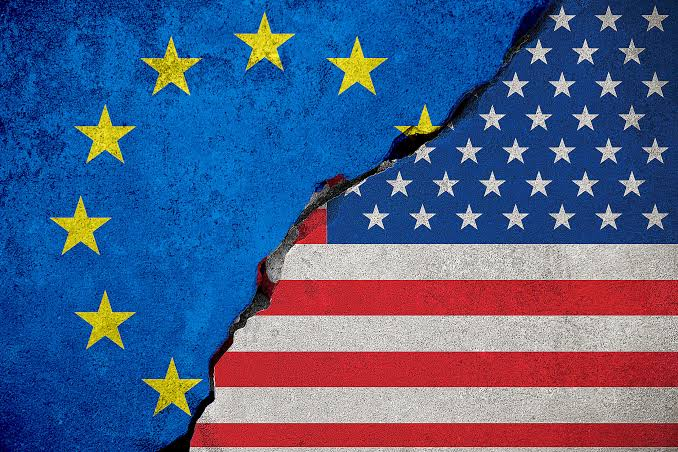
Washington and Brussels are navigating a new era of economic uncertainty. Despite a landmark trade agreement, disputes over tariffs, industrial protection and international competition continue to raise questions about the future of transatlantic relations.
WASHINGTON / BRUSSELS — October 22, 2026
The economic relationship between the United States and Europe has entered a new and complicated chapter.
After months of negotiations, political tensions and uncertainty surrounding international trade, Washington and Brussels are working to implement a trade framework intended to prevent a damaging escalation of tariffs.
But the agreement has not eliminated every disagreement.
At the center of the debate are US President Donald Trump and European Commission President Ursula von der Leyen, whose negotiations have helped reshape the rules governing one of the world’s largest economic partnerships.
The central question is no longer simply whether a trade war can be avoided, but whether the new arrangements can deliver lasting economic stability.
How the US–Europe Trade Conflict Began
The latest period of transatlantic trade tensions intensified in 2025 when the Trump administration introduced sweeping tariff measures affecting numerous trading partners.
The White House argued that tariffs could strengthen American manufacturing, protect domestic industries and address trade imbalances.
European leaders, however, expressed concerns about the consequences for exporters, businesses and consumers.
Industries including automobiles, machinery, metals and consumer goods faced growing uncertainty as companies attempted to anticipate changes in trade policy.
The dispute also raised a wider question: could two historically close economic partners find themselves engaged in a prolonged confrontation over international trade?
By July 2025, both sides had moved toward a negotiated solution.
Trump and von der Leyen: The Agreement That Changed the Negotiations
On July 27, 2025, Donald Trump and Ursula von der Leyen announced a trade agreement in Turnberry, Scotland.
The political understanding was subsequently developed into a joint framework announced in August 2025.
A central element was a US tariff ceiling of 15% on most goods originating in the European Union, subject to specific exceptions and sectoral arrangements.
The European Union, in turn, committed to eliminating tariffs on American industrial goods and expanding market access for certain agricultural and seafood products.
The arrangement was designed to reduce uncertainty and establish more predictable conditions for businesses on both sides of the Atlantic.
However, the agreement also attracted criticism.
Some European observers questioned whether the terms were sufficiently balanced, while others argued that compromise was preferable to an escalating tariff dispute.
2026 Brings Another Unexpected Turning Point
The tariff debate entered a new phase on February 20, 2026, when the US Supreme Court ruled against the use of emergency economic powers to impose certain broad tariffs.
The ruling created new uncertainty about the legal foundations of American trade policy.
The Trump administration responded by introducing a different import surcharge mechanism.
European officials expressed concern about whether the new measures would remain consistent with the commitments established under the transatlantic trade agreement.
The situation demonstrated how quickly the rules governing international commerce could change.
For businesses, the legal uncertainty was almost as significant as the tariffs themselves.
Companies planning production, investment and cross-border shipments require predictable rules, particularly when major supply chains operate across multiple countries.
Europe Takes a Major Step in June and July 2026
Despite the earlier uncertainty, the European Union proceeded with the implementation of its tariff commitments.
On June 25, 2026, the Council of the European Union formally approved legislation implementing key elements of the trade agreement.
The new EU tariff arrangements entered into force on July 1, 2026.
These measures eliminated duties on a broad range of American industrial products and introduced preferential treatment for selected agricultural and seafood imports.
European lawmakers also included safeguards to protect the EU’s economic interests if the United States fails to respect the agreed framework.
The legislation demonstrated Brussels’ intention to maintain commercial cooperation while preserving mechanisms for responding to future disputes.
Why Steel and Aluminium Remain a Major Problem
Although the trade agreement established a general tariff ceiling for most European exports, steel and aluminium remain among the most sensitive sectors.
Certain metal products and derivatives have faced US duties reaching 50%.
These measures have become an important source of concern for European manufacturers.
Steel and aluminium are essential to construction, automotive manufacturing, machinery and numerous industrial supply chains.
Higher import duties can increase costs for companies that rely on international sourcing.
The European Union has established a deadline of December 31, 2026, for the United States to bring relevant steel and aluminium derivative tariffs into line with the agreement’s 15% ceiling.
If that does not happen, Brussels has mechanisms allowing it to suspend certain trade concessions.
This makes the final months of 2026 particularly important for transatlantic negotiations.
What Does the Tariff Conflict Mean for Ordinary Consumers?
Trade policy often appears distant from everyday life.
However, tariffs can influence the prices of imported goods, manufacturing costs and business investment decisions.
When a government imposes an import tariff, the duty is generally paid by the importing company.
Businesses may absorb the additional expense, negotiate with suppliers or pass part of the cost on to customers.
As a result, consumers can experience price changes even when they are not directly involved in international trade.
European and American households could be affected through products such as vehicles, electronics, clothing and certain food items.
The precise impact depends on the goods involved, exchange rates, competition and the ability of businesses to adjust their supply chains.
Could American and European Companies Lose Their Competitive Advantage?
International trade restrictions can create winners and losers.
Some domestic producers may benefit from reduced competition with foreign suppliers.
Other businesses may face higher input costs, fewer export opportunities or disruptions to established commercial relationships.
Small and medium-sized enterprises can be particularly vulnerable because they often have fewer resources to adapt to regulatory changes.
Larger multinational businesses may be able to shift production, modify distribution networks or diversify suppliers.
But such adjustments can be expensive and may take years to complete.
The longer uncertainty persists, the more difficult it becomes for companies to make confident long-term investment decisions.
The Global Impact: Why Other Countries Are Watching Closely
The relationship between the United States and European Union extends far beyond the Atlantic.
Together, their markets represent a substantial share of global economic activity.
Trade decisions made in Washington and Brussels can influence investment flows, commodity demand and international supply chains.
Manufacturers in Asia, exporters in emerging economies and multinational logistics companies all have reasons to monitor transatlantic developments.
A prolonged dispute could encourage businesses to reorganize global supply networks.
Conversely, a stable EU–US arrangement could help reduce uncertainty for international investors and trading partners.
Will There Be Another Trade Escalation Before 2027?
The possibility of renewed tensions remains one of the most important questions facing policymakers.
Several developments could determine what happens next.
The first is whether both sides continue implementing their agreed tariff commitments.
The second is whether outstanding disputes involving steel and aluminium can be resolved before the end of 2026.
The third involves future US trade investigations and whether additional duties could affect European exporters.
Finally, political pressure within both economies may influence the willingness of leaders to make further concessions.
For now, neither a complete collapse of the agreement nor a renewed tariff escalation is inevitable.
Much will depend on negotiations and policy decisions during the coming months.
A New Economic Era for the United States and Europe
The tariff dispute of 2025 and 2026 has highlighted a fundamental change in international economic relations.
Trade is increasingly connected to national security, industrial policy, technological competition and political influence.
Governments are paying greater attention to where essential goods are produced and how dependent their economies have become on international suppliers.
For the United States, the priority remains strengthening domestic industry and protecting strategic economic interests.
For the European Union, the challenge is to preserve access to global markets while maintaining economic competitiveness and political independence.
These objectives do not always align.
But the enormous scale of transatlantic trade gives both sides strong incentives to continue cooperating.
Conclusion: Is the World Entering a New Trade Order?
The US–Europe tariff dispute has become one of the defining economic stories of 2026.
What began as a confrontation over import duties has evolved into a wider debate about competitiveness, industrial security and the future of globalization.
The agreement reached by Donald Trump and Ursula von der Leyen has helped establish a framework for cooperation, but unresolved questions remain.
The next major test comes at the end of 2026, when outstanding disputes over metals tariffs could determine whether relations stabilize further or face another period of tension.
For businesses, investors and consumers, the consequences could extend well beyond the immediate negotiations.
The decisions taken in Washington and Brussels today may influence international commerce for years to come.

Written by Fort Never
Trip-hop, electronic dub and lo-fi folk from Austin, Texas. We write about sound, the Austin scene and the craft of independent music. About the band →